
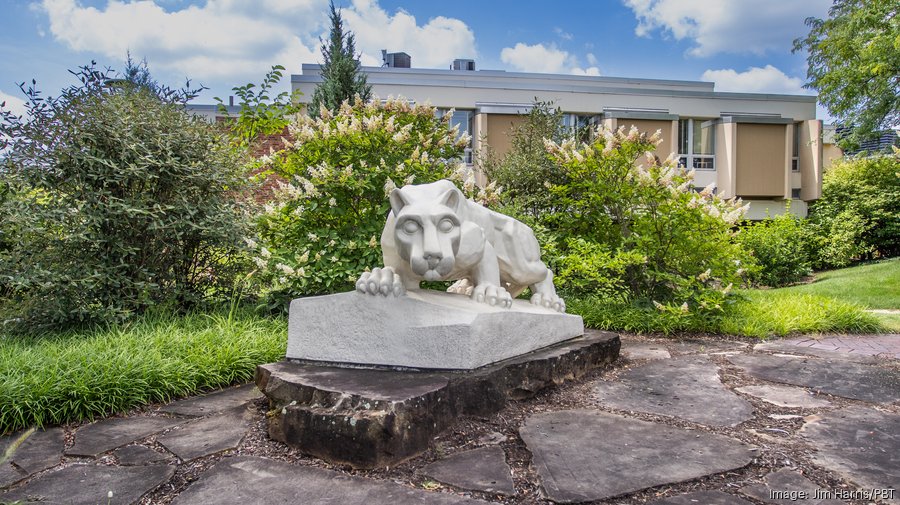
The Nittany Lion statue on Penn State New Kensington’s campus. (Jim Harris/PBT)
By Riley Dunn, Pittsburgh Business Times
Just minutes away from Penn State Fayette, The Eberly Campus, Bill McKool, owner of McKool Properties, is working on changing his approach toward marketing rental properties at University Commons Apartments.
In the next two years, McKool plans on pivoting from a focus on incoming college students to one on Fayette County newcomers, due to the Fayette campus’ impending closure in 2027, which was announced earlier this year.
“Two years to transition from student housing to non-student housing isn’t ideal, but we can make it work,” McKool said. “As a businessperson, you take risks whenever you go into new ventures. I’m trying to look at the positives here. I feel like we can turn this around.”
About 55-65 students have rented from McKool each year, and some of them have expressed disappointment in the closures, citing worries about potentially impacted future plans.
“New students were just concerned about how long they would stay at school and what their plan would be for moving from one school to another or if they would have to go to a campus farther away,” McKool said.
Penn State Fayette is just one of seven Penn State branch campuses that will close following the 2026-27 school year. It, along with Penn State New Kensington, is located in southwestern Pennsylvania.
As the planning process for the closures begins, people and businesses like McKool’s are looking ahead to what the next steps will be not only for university students, but also for the buildings and communities they’ll be leaving behind.
“We don’t have a formalized plan. As of right now, we are in the information-seeking portion of this,” said Scott Dunn, chairman of the Fayette County commissioners.
‘It was a blow’
Dunn, along with others in Fayette County, has established the Eberly Campus Transition Committee, a group dedicated to working with Penn State to establish a plan for the future of their community’s campus.
Dunn said the Fayette community was disappointed to hear about the closure, which Penn State trustees voted 25-8 in favor of on May 22. Currently, Penn State Fayette, The Eberly Campus, stands as the only four-year institution of higher education in Fayette County.
“It was a blow not only to the staff and the students, but also to our economic business community,” Dunn said. “Where are they going to train employees? Where are they going to hire new graduates? To not have an institute of higher learning is a blow to those trying to attract new businesses to Fayette County.”
In 2024, the Penn State Alumni Association reported 5,212 total alumni as living within Fayette County, while 11,468 reside in Westmoreland County, showing that many alumni stay close to home upon graduation. Specific alumni numbers for the New Kensington and Fayette campuses were not available.
The Eberly Campus Transition Committee now is trying to turn disappointment into opportunity. Dunn and other community representatives have been holding meetings with Penn State’s own representatives and transition team.
So far, Dunn said, there has been dialogue and communication from both sides, and he is hopeful they will find a solution both for enrolled students and Penn State properties.
Pennsylvania State Rep. Jill Cooper (R-Westmoreland) also at first expressed disappointment on hearing about the New Kensington closure in Westmoreland County, but she is hopeful that the two-year period until closure will give students time to prepare and orient themselves in the best way possible for continuing their education.
Students currently enrolled at the closing campuses will be able to finish their degree programs, and for those pursuing Penn State’s 2+2 option, they will have time to finish at their respective branch campuses before moving on to University Park.
“I hope that they’ll [Penn State] work diligently with the students in completing their dream of getting a quality education,” Cooper said in June.
This two-year window also will allow time for the New Kensington community to come together and have an “open and transparent” discussion about the empty buildings soon to be left behind by the Nittany Lions. Cooper hopes that the buildings will be able to be repurposed for the benefit of the community.
Martine Schoenwetter, an owner of the Nittany Highlands Apartments, which is located near Penn State New Kensington, said she and her apartment staff will eventually have to reevaluate what their buildings’ future use will be. However, for now, the apartments will remain available for rental until the time of the school’s closure.
The apartments are rented out to around 70-76 Penn State students each year.
“We are just disappointed that Penn State is going to close that campus,” Schoenwetter said. “It’s definitely going to affect the community as a whole financially and affect the local students who won’t have a local Penn State campus to go to.”
Redefining the approach
Penn State did not comment regarding this story beyond a statement noting that: “Penn State is committed to working with these communities, along with local and state and federal officials, on how these locations can support local needs, as well as regional innovation and economic development in the future. That work is underway, and we will have more updates as this work advances.”
Current student enrollment numbers and graduation rates were both important factors in the university’s decision to shutter the campuses.
According to the school’s student enrollment database, Penn State New Kensington enrolled 432 students in the fall 2024 semester, down from the 456 students recorded last year and nearly 100 less than the 528 reported in 2020.
Similarly, Penn State Fayette’s enrollment dropped from 577 students in 2020 to just 407 in 2024.
Both school’s graduation rates also fall below rates posted at Penn State’s main University Park campus, with Fayette’s four-year graduation rate being 44%, while New Kensington’s stands at 38.8%. University Park, in comparison, has a graduation rate of 67.6%.
“Our objective is to redefine how we approach our land-grant mission, and our Commonwealth Campuses are integral to that vision,” Penn State President Neeli Bendapudi said in a live address to the university community on May 22. “This recommendation, now ratified by the board, will allow our campuses to remain strong, competitive and responsive to the needs of students, employers and communities, even in times of great change in higher education and in the face of demographic realities.”
Despite the closures affecting the campuses, Bendapudi said that initiatives such as Penn State New Kensington’s Digital Foundry would continue to have a presence in the local communities.”
‘We have had some outreach’
Students themselves may also be looking to transfer to other schools in the area, and local universities are preparing now to help accommodate them.
Pennsylvania Western University has campuses in California, Clarion and Edinboro. The California campus is located in Washington County and is only around a half-hour away from Penn State Fayette.
David Dollins, PennWest’s associate vice president for strategic enrollment management, said that California already sees a “great deal” of interest from high school students, as well as transfer students living in Fayette County.
“We have heard from a number of students looking to see what a degree at PennWest University entails and how long it will take them to complete it,” Dollins said. “We have had some outreach from students and families as they’re starting to learn the plans for Penn State.”
Dollins said PennWest is looking to make the transfer process as efficient as possible for incoming students. Beginning in the fall 2025 semester, the school will launch its new concierge service, making a main point of contact for students looking to transfer into PennWest, either through one of their campuses or online.
“There is going to be one individual who is an expert in our transfer policies and procedures, our transfer application and our enrollment process,” Dollins said. “So they’re going to be a single point of contact that students interested in PennWest can reach out to.”
PennWest also already has a number of articulation agreements in place with various Penn State campuses that help outline how coursework completed at one learning institution will transfer to another. Because of this existing outlet, transferring should be a quick process for students.
“We’ll even work with students on waiving application fees if that’s a barrier and helping them with financial aid and scholarships,” Dollins said.
In a number of cases, he added, scholarships are available to students specifically from local counties.
“PennWest and other PASSHE (Pennsylvania State System of Higher Education) schools remain the most affordable four-year bachelor’s degree programs in the state. That’s something that our Board of Governors and [PennWest] President [Jon] Anderson are very focused on — making sure students have an affordable education and have funding and scholarships available to help offset the costs of tuition,” Dollins said.
Another local option for students looking to transfer or explore other opportunities is Westmoreland County Community College, which serves both the Fayette and New Kensington areas.
“Westmoreland County Community College serves the region with multiple educational centers, and we will continue to support students throughout Westmoreland, Fayette and Indiana counties,” Kristin L. Mallory, the college’s president, said in a statement. “If there are students who wish to continue their education, we would welcome those students to meet with our college and determine how we can fulfill their needs. We have transfer agreements with many universities, and we are all focused on helping students move forward to achieve their goals even when change occurs.”
Currently, the community college has articulation agreements with several colleges and universities, including Penn State and its regional campuses.
While the Pittsburgh region must adapt to Penn State’s sweeping changes in the next few years, communities, organizations and businesses are coming together to help ensure the transition is as smooth as possible. In order to track changes being made, Penn State has put together a website meant to act as a “road map” for the Commonwealth Campuses’ futures. On the site, people can track the latest news from the university and provide feedback to the school’s leadership team.
“I recognize — believe me, I do — that the past several weeks, indeed months, have caused heightened concern and uncertainty. I want you to know that I hear you and I see you, and I care deeply about every student, faculty member, staff member, donor, alum and community stakeholder impacted by this moment,” Bendapudi said in her May 22 announcement of the closures. “As we move through this period of change over the next two years, I want to be crystal clear about one thing: Our people come first.”
Riley Dunn is a student at the University of Iowa and one of 10 Pittsburgh Media Partnership summer interns.
 Pittsburgh Media Partnership