
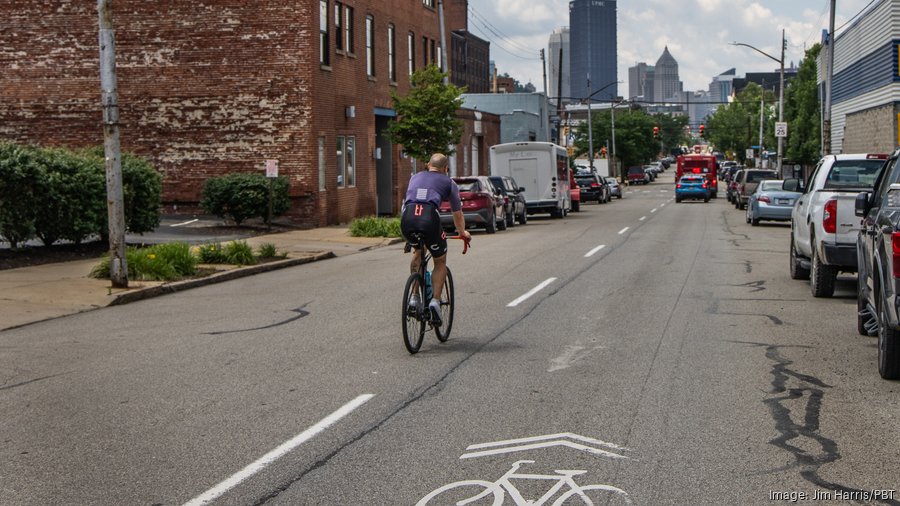
Bicyclist heading toward the Strip District at 31st Street and Penn Avenue. (Jim Harris/PBT)
By Riley Dunn, Pittsburgh Business Times
With the City of Pittsburgh planning on reshaping its historic Strip District by transforming its current two-lane Penn Avenue into one and adding a new bike lane, local businesses are raising concerns about the idea.
The project was proposed by the city’s Department of Mobility and Infrastructure (DOMI) in May 2024. While the lane switch-up is meant to make Penn Avenue safer, there have been differing opinions on just how effective it will be.
Currently, the reshaping efforts would, if approved, be enacted on Penn Avenue between 22nd and 31st street.
“I am all for bike lanes where they make sense, and I use them. But this doesn’t make sense and would have a net negative impact on overall safety in this case,” Tim Gaber, founder of The Original Pittsburgh Winery, said in an email to the Pittsburgh Business Times. “The impact of this proposal on our business would be existential and would definitely force us to close our doors if this is allowed to move forward.”
Gaber serves on the Strip District Neighbors board of directors and both lives and works in the heart of the affected area. Each day he uses the street both to walk his dog and ride his bike, and he feels safe and comfortable while doing so.
His business, the Winery, frequently hosts live music and shows for the Pittsburgh community.
“Independent music venues provide a much needed community service, with little margin, and the hindrance of a traffic choke point like this would render us inoperable financially,” Gaber said. “The loss of another locally owned and operated music venue would be 100% the fault of the city and needs to be stopped.”
In addition, truck deliveries to the Winery usually stop in one travel lane, having no room to pull over, while traffic is able to flow through the other. For Gaber and other business owners — many of whom joined the Strip District Business Association in opposition to the project — this potential traffic hold-up poses a risk not only to deliveries, but also to emergency vehicles.
“Our aerial trucks, essential for search and rescue operations, ventilation, and victim and firefighter extrication, require a minimum operational width of 14 feet 7 inches to safely deploy outriggers and operate the aerial ladder,” Ralph Sicuro, president of Pittsburgh Fire Fighters, said in a statement on the Business Association’s website. “The proposed reduction to an 11-foot-wide lane would render aerial operations inoperable, severely compromising our ability to respond effectively to emergencies.”
In the past year, the Association has organized a petition against efforts to change Penn Avenue and also has collected comments from visitors and business owners, which are posted on its website.
According to that same site, 97.6% of surveyed business owners disagreed with the rightsizing project, 2.4% remained neutral and 0% agreed.
The group also addressed the safety of Penn Avenue, stating that accidents declined by 21% from 2022 to 2023 due to recent infrastructure upgrades, according to data found on the government’s crash data dashboard. Due to this, several business owners believe that changing the entire makeup of the street is unnecessary.
Yet, according to DOMI’s website, Penn Avenue has the highest crash to traffic volume, with 115 accidents — including 45 injuries — occurring in the five-year period between 2018 and 2022. The city did not respond to requests for comment.
“I’m no traffic engineer, but clearly the goals of the right-sizing project were grounded in safety concerns,” said Pamela Austin, president of Strip District Neighbors. “I happen to live in the Strip District at 25th and Smallman, and I’ve witnessed several accidents at that intersection.”
Austin noted that since the project’s announcement, business owners who are part of Strip District Neighbors have had discussions about potential challenges that their businesses could face with its implementation.
“It will cause challenges for them, everything from loading to parking to traffic backups,” Austin said. “I know that there were alternatives proposed for the city to consider. Could there be speed bumps? Could there be traffic lights?”
When considering effects on his own business, Tim Ludwig of Jim Ludwig’s Blumengarten Florist located at 2650 Penn Ave., referenced the Strip District’s projected population growth, along with a multitude of other projects that also are set to impact traffic in the area. The projects, which include the proposed changes to Penn Avenue, are included under DOMI’s Strip District Mobility Projects and can be found on DOMI’s website.
“The reason why our business located here was access. Centrally located in the city and very close to wholesalers allows us to service most of Allegheny County. Our wholesalers are now finding it harder to work within the Strip District,” Ludwig said.
While Ludwig believes his business will personally be able to adapt to the lane changes due to its corner location and a parking lot, he worries the new scheme will negatively impact trucks that need to unload and transport products to and from businesses.
“Trucks cannot wait in the only traffic lane for someone to come ticket and tow a car parked in a loading zone,” he said.
As efforts are organized to stop the project, there are some who stand with the idea.
This includes BikePGH, an organization that seeks to reduce car dependency within the city and make it overall more bike-friendly. The organization has responded to DOMI’s plans by making its own petition, this time in support of the reimagined Penn Avenue.
According to Advocacy Director Eric Boerer, the petition has been signed by around 2,500 people.
“When we launched that petition, we had overwhelming support. We got thousands of signatures from all types of people who really just want to be able to get to the Strip District safely,” Boerer said.
For Boerer, safety is a top priority. He believes the new roads will help to reduce crashes for bicyclists, pedestrians and drivers.
“The Strip is one of the fastest-growing neighborhoods. And if we don’t accommodate people who want to get there by biking, walking and transit, it’s only going to get more cars. It will increase traffic because people don’t feel safe doing anything but driving,” Boerer said.
He also maintains that having more bikers in the area might actually increase some business’ customer bases if people ride in from the surrounding communities.
“Cars are going too fast, and they’re hurting people,” he said.
DOMI created an Engage Page with updates about the project. Currently they are in the planning stages. The city will host a pre-construction public meeting before making any changes, though the date is yet to be announced.
Riley Dunn is a student at the University of Iowa and one of 10 Pittsburgh Media Partnership summer interns.
 Pittsburgh Media Partnership