
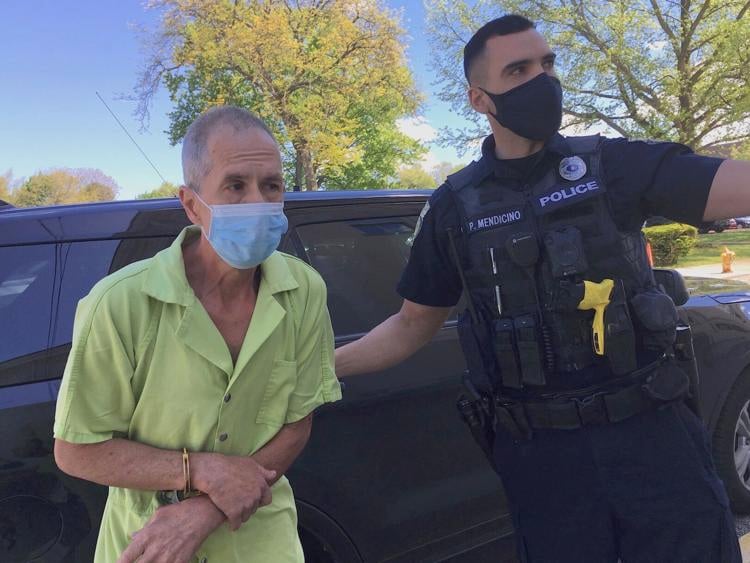
New Castle police officer Peter Mendicino escorts Louis Esposito into district court for his arraignment in this May 13 photo, the day after he reportedly stabbed his mother and landlord to death and shot a neighbor in the chest. (Debbie Wachter/News)
By Debbie Wachter and Annabelle Chipps, New Castle News
A forensic psychiatrist attributed Louis Vincent Esposito’s mental state as being under the influence of crystal methamphetamine the night he killed his mother and landlord and shot and injured his neighbor.
Dr. Phillip J. Resnick of Cleveland, a forensic psychiatrist and medical doctor who has credentials in psychiatric counseling and testimony in significant national homicide cases, told a jury and the court via Zoom that in his opinion, Esposito’s mindset did not meet the state’s legal definition of insanity when he committed the acts on May 12, 2021.
Esposito’s murder trial this week is based on his not-guilty plea by reason of insanity in front of Lawrence County Common Pleas President Judge J. Craig Cox.
Esposito is accused of stabbing his mother, Margaret Kahrer, to death 19 times and his landlord John Micco, 17 times. He is also accused of shooting his neighbor, Kevin Boston, in the chest just after showing him his father’s shotgun.
Resnick was called as a rebuttal witness to the defense by Lawrence County District Attorney Joshua Lamancusa, who is co-prosecuting the case with Assistant District Attorney Emily Sanchez-Parodi. Lamancusa took over the questioning of both Resnick and a defense witness, Alice Applegate, a licensed psychologist who was called by Esposito’s court-appointed defense attorney John Bongivengo to testify on his behalf.
Resnick said he arrived at his conclusion by evaluating Esposito after reviewing all of his counseling records, police videos from the night of the homicides and a six-hour interview with him on July 9, 2024. He reviewed a total of 29 pieces of information that also included a ruling against him by a federal Social Security judge who determined him ineligible for Social Security.
He said although Esposito had been counseled by a local psychiatrist, he was never diagnosed with severe mental illness at the conclusion of his care with him.
“Mr. Esposito has a big history of drug use,” Resnick said.
Drug usage
He said Esposito told him in his interview he has used cannabis since he was 20 then went to cocaine use “very heavily” for a period. He used opioids since he was 21. He got into a methadone clinic and worked himself off of them in 2013, Resnick said.
“He told me he started using crystal meth about six months before” the incidents occurred, the doctor related. “He said he couldn’t go more than five minutes between hits,” he said, adding Esposito’s weight fell from 180 to 115 pounds and he became extremely reckless while driving and in his tree-cutting business.
“I think it was reckless conduct, but he wasn’t trying to kill himself,” Resnick concluded.
His local psychiatrist documented periods of depression, anxiety and difficulty sleeping, he said, and that doctor diagnosed him with anxiety disorder and depression.
Resnick noted a Social Security judge in a case for Esposito to collect on disability ruled there was no evidence of bipolar or psychosis, delusions or hallucinations.
Familial relationships
Resnick said Esposito divulged he was living on his own and couldn’t pay his own rent, so he moved in with his mother and his disabled brother at 1019 Dewey Ave., a duplex Micco owned. Micco lived in the other side, at 1017 Dewey. He said he did work for Micco, but they had arguments, Resnick testified, and “Mr. Micco threatened to evict him.”
Esposito described Ross to Resnick, saying he worked with him in his tree-cutting business. When he went out of the business, he gave some of his equipment to Ross. He described no hostility between them, Resnick continued.
Esposito described his mother to Resnick as a woman who was progressively battling dementia with a long history of schizophrenia. She still did things around the house, but he felt like a caregiver, Resnick said. Esposito told Resnick about an argument with Micco when the landlord said he was evicting him that day, which might force Kahrer into a senior care center.
Esposito confronted Micco in his house, saying he felt like he had killed his mother, he told Resnick. He then stabbed Micco to death with a kitchen knife.
“He said, ‘My body may have done it, but not my soul,” Resnick said, deducing Esposito was in an altered mental state because of his voluntary crystal meth intoxication. “I would say, Mr. Esposito did not meet the criteria for legal insanity in Pennsylvania.” He emphasized no state allows meth intoxication as defense in an insanity act.
Resnick said he felt Esposito knew the nature of his acts and was still high when he was interviewed by the police.
He said he was conscious of his actions and knew the wrongfulness of his conduct, evidenced by knowing to cover Micco’s Ring camera with aluminum foil, moving furniture to stage a burglary and telling police he deserved solitary confinement.
Regarding Esposito’s claim to the doctor to being on crystal meth, Bongivengo in cross examination said, “What if he wasn’t?”
Resnick said Esposito had not been drug tested that night.
Defense witness
Applegate, Bongivengo’s defense witness, summoned Thursday morning by Zoom, is a licensed psychologist who is neither board-certified nor a medical doctor. She testified that she felt crystal meth was a factor in Esposito’s mental state deteriorating.
She said she performed a psychological evaluation after a five-hour interview with Esposito on Sept. 27, 2022. She said she also proctored seven written psychological evaluations and Esposito underwent several tests that led to her conclusions. Those, combined with information from school and medical records, led to the diagnosis of Esposito with a schizophrenic spectrum disorder, she said.
“He was not of sound mind. You can confess and not be of sound mind at the same time,” Applegate said. “He was out of touch with reality.”
Esposito told her he felt like he was watching what was going on that night and that he felt like he was possessed. He admitted to her that he used crystal meth and had begun taking it after no longer taking Seroquel, a sleep disorder drug, she told the court.
“In some ways, he was trying to self-medicate,” Applegate said.
Applegate shared details in her testimony about Esposito’s account of his family life. His father died in September 2020, leaving him as caretaker of his schizophrenic mother and wheelchair-bound brother. His mother had been treated for her schizophrenia by the same psychiatrist who treated him.
Esposito also had previously been married 17 years and was divorced, Applegate said. He told her that he had children.
Lamancusa, upon cross-examining, tore into her credibility by asking if she interviewed any family members or if she watched the police interview or Ring camera video when she made her collective diagnosis of his mental condition. She said she did not interview his family and she did not review the Ring camera footage. She said she was unable to play them on her computer.
She said Esposito had been receiving psychiatric treatment from the Matta and Matta practice in New Castle since 2003, according to Social Security records. He was diagnosed with an anxiety disorder, insomnia and depressive episodes. At one time, he was put on Seroquel to treat the insomnia, though it is also used to treat bipolar disorder and schizophrenia, Applegate said.
“This is a heavy medication. You wouldn’t have been treated with it for over 20 years without some kind of mental disease,” Applegate said. Doctors attempted to get Esposito off the medication in 2016, but he returned to it after six months.
“I do better when I’m on the Seroquel,” he allegedly said to Applegate. “The treatment was working,” she told the court.
Six months prior to the killings, Esposito stopped taking his medication again and ceased sessions with Matta. Applegate said there is typically a termination phase for therapy, but she claimed Matta did not follow this protocol.
Applegate described Esposito’s mental state at the time of the incident as “constantly shifting.”
Annabelle Chipps is a recent graduate of Slippery Rock University and one of 10 Pittsburgh Media Partnership summer interns.
 Pittsburgh Media Partnership