
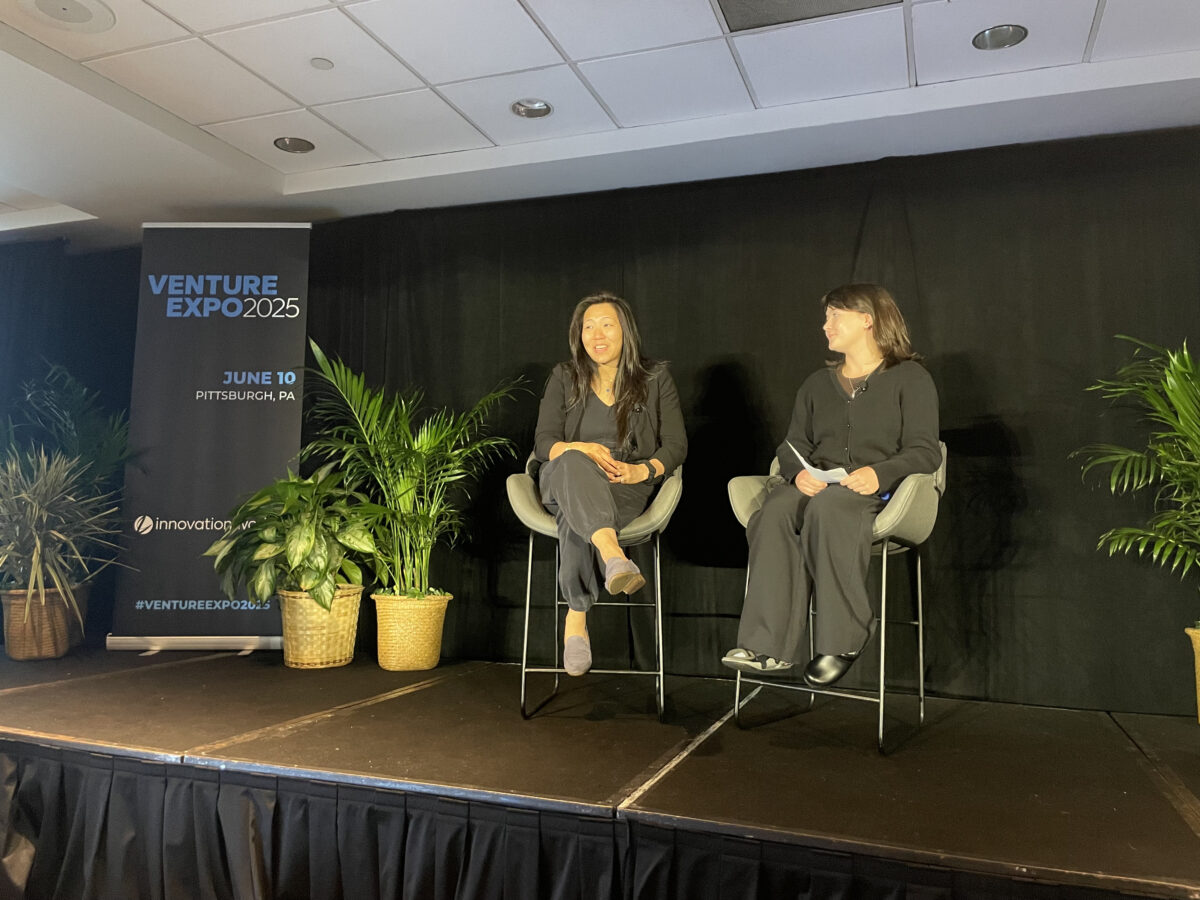
Senior strategist for Duolingo, Sisi Liu, with Innovationworks’ Sophie Burkholder at Ventureworks Expo. (Photo by Gavin Petrone/Technical.ly)
By Gavin Petrone, Technical.ly
Duolingo is continuing to explore AI-related partnerships to improve its curriculum, despite backlash from a recent announcement.
But there’s way more to the unicorn language learning app’s strategy for growth than just that, senior strategist Sisi Liu told Technical.ly at Innovation Works’ Venture Expo on Tuesday. One key tenet is buying up other companies. A recent string of acquisitions highlights the company’s approach: It brings in tech and talent that’s better than what it could efficiently develop in-house, according to Liu.
“It’s not like anything has materially changed about the facts of the world,” Liu told Technical.ly. “There’s really, really cool innovations happening around foundation models, and around what that can mean for creating better education products. So, I think our stance on that is full steam ahead on finding really top-tier companies that can help bring new features to Duolingo.”
The recent fireside chat follows a wave of backlash after the company’s CEO, Luis von Ahn, said in April that it would shift to an “AI-first” organization. The original announcement by von Ahn included reducing human contractors if AI could perform their duties, but he has since clarified that AI will not replace human workers at Duolingo.
“It’s about creating access to learning experiences that don’t necessarily already exist for a lot of people,” Liu said. “It’s not saying, ‘Hey, you’ll replace one for one the foreign language teacher you have, or the tutor that you work with on a weekly basis, or whatever to practice language learning.’ It’s a supplemental experience on top of that.”
It’s all a part of what the edtech company calls its “Green Machine,” Liu said. Duolingo emphasizes building long-term relationships as it seeks out new partners to purchase and targets specific gaps in its own infrastructure to fill.
(For more of the story, visit Technical.ly)
Gavin Petrone is a student at Point Park University and one of 10 Pittsburgh Media Partnership summer interns.
 Pittsburgh Media Partnership