
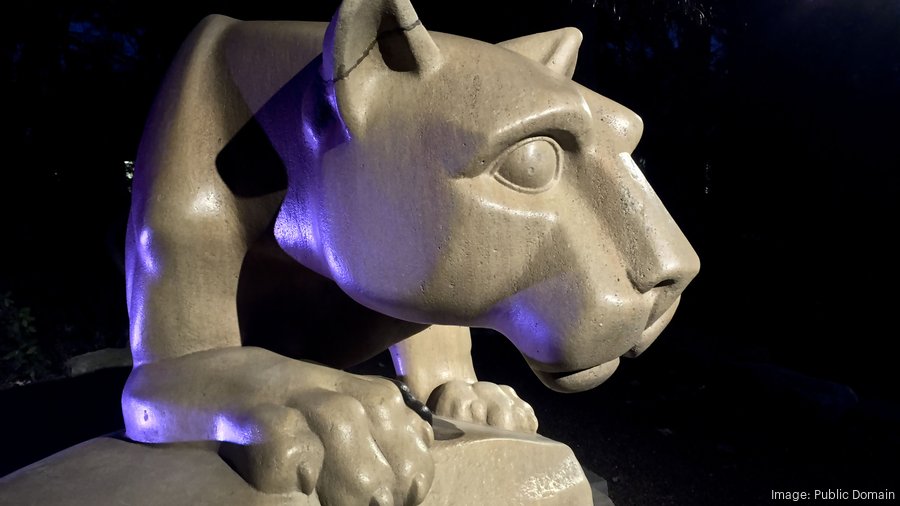
The Lion Shrine on the campus of Penn State University. (Ann Taylor-Schmidt, Penn State Office of Social Media)
By Riley Dunn, Pittsburgh Business Times
Over the next two years, Penn State will close the doors of seven of its 19 branch campuses forever, including Penn State Fayette, The Eberly Campus, and Penn State New Kensington located in the Pittsburgh region. While these campuses serve only a small percentage of Penn State students, both of their closures will have big impacts on the businesses and communities that surround them.
“This closure has been a disappointment,” Pennsylvania State Representative Jill Cooper (R-Westmoreland) said. “The New Kensington location has been a great location for Penn State as part of their land-grant mission.”
Cooper said the closure of Penn State New Kensington, which falls in her congressional district, will have a lasting impact on the community around it. While attending school, many students come and live on campus for a majority of the year, affecting everything from local businesses to the housing market.
“Penn State New Kensington was already looking at trying to serve the ever-changing growth that is happening in western Pennsylvania in the areas of robotics, advanced manufacturing and health care,” Cooper said. “They had developed two new programs in Electro-Mechanical Engineering and Radiological Sciences that were trying to be feeders to businesses moving into that area.”
Cooper said she would’ve liked to see more focus from Penn State on New Kensington’s value to the community, as well as a focus on giving students, faculty and community members more time to make changes and prepare for the upcoming closure. The closures were announced by the board of trustees on May 23, with plans for the campuses to wind down after spring 2027.
Despite feeling disappointed about the closure, however, Cooper remains optimistic that the two-year timeframe will give students time to prepare for their next steps as they finish out their education — whether they are staying at another Penn State campus or transferring elsewhere.
“I hope that they’ll [Penn State] work diligently with the students in completing their dream of getting a quality education, if that’s what they want,” Cooper said.
The two-year window also will allow people in New Kensington time to have “open and transparent” discussions about the empty buildings soon to be left behind by Penn State and how they will best be repurposed to the benefit of the community.
While the closures of Penn State’s branches are affecting the New Kensington area, they also have a resounding impact on Fayette County.
“The closure of Penn State Fayette, The Eberly Campus, is not only a profound loss for education in our region — it carries significant and far-reaching economic implications for Fayette County,” Tim Flecker, executive director of the Fay-Penn Economic Development Council, said in an email. “As one of the most economically challenged counties in the Commonwealth of Pennsylvania, the Eberly Campus has been a beacon of educational opportunity in our community.”
Flecker also wrote that the campus has historically acted as a pipeline for skilled students who, upon graduating, have entered the local workforce. With the upcoming closures, there is a worry that students without access to affordable and high-quality local higher education will leave the Fayette area in search of other opportunities.
“The Eberly Campus contributed to Fayette County’s appeal to prospective residents, investors and businesses who saw in it a sign of growth, opportunity and intellectual vitality,” Flecker said.
Despite believing that the loss of the campus is a loss for the county, Flecker also can empathize with the trustee’s decision due to changing demographics within the student population.
One reason behind the closure is declining student enrollment and retention over the previous academic years and the low graduation rates reported at many of the branch campuses. At Penn State Fayette, the graduation rate is 44%. That number drops to only 38.9% at Penn State New Kensington.
Bill McKool, owner of Bill McKool Properties, rents apartments out to about 55-65 students attending Penn State Fayette each year. The upcoming closures have been disappointing for McKool, primarily because he only recently purchased the apartment properties.
The news has also been disappointing for his students.
“New students were just concerned about how long they would stay at school and what their plan would be for moving from one school to another, or if they would have to go to a campus farther away,” McKool said.
Since hearing the news, McKool himself has worked on changing his game plan and approach toward marketing rental properties. Instead of focusing on college student housing, McKool Properties will pivot to promoting their apartments to Fayette County newcomers.
“Two years to transition from student housing to non-student housing isn’t ideal, but we can make it work,” McKool said. “As a business person, you take risks whenever you go into new ventures. I’m trying to look at the positives here. I feel like we can turn this around.”
Similarly, Martine Schoenwetter, one of the owners at the Nittany Highlanders Apartments in New Kensington, said she and the rest of the apartment staff will have to eventually reevaluate what to use their buildings for, though the apartments will stay available for rental by New Kensington students up until the closure.
Nittany Highlanders Apartments rents to around 70-76 Penn State students each year. About half of those students are local and come from the New Kensington area, while the other half come from out-of-state.
“We are just disappointed that Penn State is going to close that campus. It’s definitely going to affect the community as a whole financially, and affect the local students who won’t have a local Penn State campus to go to,” Schoenwetter said.
Riley Dunn is a student at the University of Iowa and one of 10 Pittsburgh Media Partnership summer interns.
 Pittsburgh Media Partnership