

Samira Fazli looks out over her deck in the Hilltop region on a recent Saturday morning. (Photo by Tracy Certo)
By Tracy Certo, Pittsburgh Tomorrow
Two weeks before she escaped Afghanistan with her family, 22-year-old Jamila got married in a traditional Afghan ceremony. She and her young husband were looking forward to blissful married life and a much brighter future in the United States.
The couple, along with Jamila’s family, had obtained Special Immigrant Visas (SIVs), granted to those who had worked alongside the U.S. government in Afghanistan. These visas held the promise of a new life, free from the specter of Taliban reprisal.
As they arrived at the airport gate that fateful day, her husband was stopped for routine paperwork check and then abruptly turned away due to paperwork complications, they said. It happened fast and without explanation. In that tense and tumultuous moment, Jamila had to choose — go and hope that he would soon follow or stay in the country that was becoming increasingly dangerous to young women.
Getting on that plane was the hardest decision Jamila ever made.
“I had to leave my husband at the airport, while I was also leaving the only home I’ve ever known,” she said. “At that time, I was confident I’d be able to bring him to the United States soon enough.”
The family’s long journey took them first to Qatar and then to a German refugee camp, where they spent a month in uncertainty. “It was like a holding pen,” Jamila said. “We didn’t know what would happen next, but we were safe, and that was all that mattered.”
After a month in Germany, they were flown to Texas, where they spent two months in a refugee camp under challenging conditions. Despite the intense heat and minimal facilities, the family persevered, driven by the hope of a better future. One day they were finally assigned to a city for resettlement: Pittsburgh.
Arriving in their new city brought relief, as well as new challenges. Language barriers, cultural differences, and fear of the unknown weighed heavily on them. “Everything was so different,” Jamila said. “We didn’t know anyone, and we had to start from scratch.”
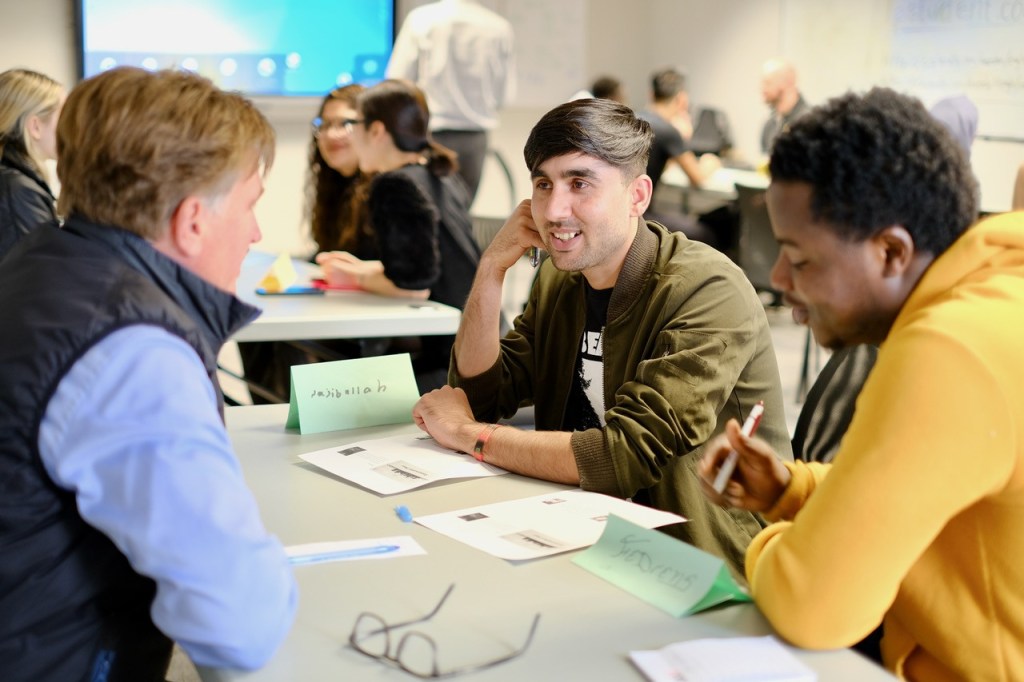
Practicing English conversation at Literacy Pittsburgh, where Samira continues to learn English. (Photo by Tracy Certo)
Growing up in Afghanistan, Jamila had dreamed of pursuing an education for a better life. As the Taliban regained control, the threat to safety increased, particularly for women like her who sought education and independence.
In August 2024, a United Nations agency reported that the Taliban have deprived 1.4 million Afghan girls of schooling through bans. In 2021, when they took power, the Taliban ended education for girls above sixth grade, saying it didn’t comply with Islamic law. Afghanistan is now the only country that bans secondary and higher education.
Determined to seize the opportunity to continue her education in this country, Jamila enrolled in Brashear High School, completing her junior and senior years. In June 2023, she graduated from high school.
Her passion for learning continued at the Community College of Allegheny County, where she studies Computer Science. She dreams of reuniting with her husband and building a stable future working in information technology. “I knew I needed to focus on my education, even with everything that was happening in my life. I’ve always been fascinated by technology,” she explained. “It’s the key to a better future, not just for me but for my entire family.”
Her father, who once worked at the U.S. Embassy in Kabul, now labors in a local restaurant to support them. “He works so hard, but it’s not easy. We all miss home, but we’re trying to build a new life here.”
Local resettlement organizations provided support to secure housing and food, and Jamila connected with Literacy Pittsburgh to improve her English. “I didn’t know much English when I arrived,” she said. “Watching YouTube videos and attending classes helped a lot.”

Samira displays a literacy book she uses to hone her English skills. (Photo by Tracy Certo)
Her siblings also have been adjusting to their new lives. Her older brother is finishing high school and plans to find a job, while the younger ones are quickly learning English and adjusting to American schools. “It’s a big change for all of us, but we’re managing.”
Through it all, Jamila longs for her husband, who is still in Afghanistan, trapped by visa complications and excruciating wait times. “It’s been three years, and we’re still waiting,” she said, her voice breaking. “We’ve tried everything — lawyers, forms, even reaching out to Congress — but the process is very slow.”
Jamila’s plight is compounded by her lack of a travel document or green card, preventing her from returning to Afghanistan or meeting her husband in a third country. While the rest of her family has had their green card applications approved, her status remains in limbo because of her marriage, which technically renders her not a part of her father’s family in the eyes of immigration authorities.
This painful reality weighs heavily on Jamila, as she pines for the day when she can reunite with her husband and resume the life they imagined. In the face of these obstacles that seem insurmountable, she refuses to lose hope.
“Every day is a step forward and every single day, I pray for his safe return. I believe in the future.”
(Editor’s note: Names were changed in this story to protect identities.)
This story is part of The New Americans, a project of Pittsburgh Tomorrow, which seeks to reverse population loss through revitalization. See more stories here.
 Pittsburgh Media Partnership