
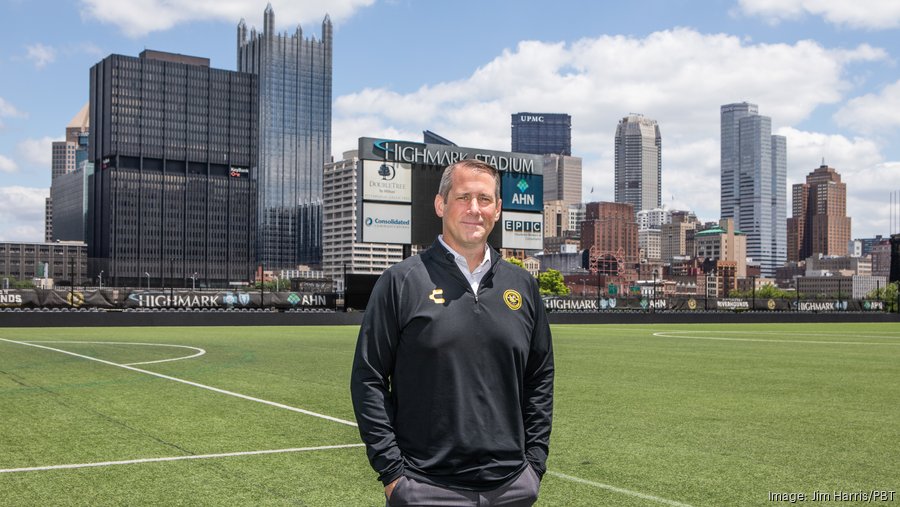
Jeff Garner, president, Pittsburgh Riverhounds SC at Highmark Stadium. (JIM HARRIS/PBT)
By Mitra Nourbakhsh, Pittsburgh Business Times
Two years ago, Jeff Garner left behind a job as president of the Orange County Soccer Club — and the California sun — to move back to his native Pennsylvania. As president of the Riverhounds, Pittsburgh’s professional soccer club, Garner has steered the organization through a whirlwind of changes and initiatives. In March, the ownership group requested a $10 million state grant through the Redevelopment Assistance Capital Program to renovate Highmark Stadium. In April, it announced the addition of a professional women’s league team. In May, plans for a new multifield sports complex in Westmoreland County were unveiled. Garner oversees all of the above; his goal is to ensure everything works together to be as successful as possible. By this point in his 24-year career, Garner has tried just about every sport in the book: A football player in college, he went on to work in professional baseball and then as assistant athletic director at Penn State. Soccer has come just in the past five years, but Garner’s fan-first approach has created a team that is consistently selling out games and now looking to expand.
You’ve worked in a lot of different sports throughout your career. How did you transition to soccer?
There really was no transition. I’ve noticed throughout my career that there’s some nuance to it, but the sport itself doesn’t matter a ton. You’re getting people in; you’re getting people out; you’re entertaining them while they’re there. I was able to apply the stuff I had learned along the way to soccer. I will say, funny story, I had to adjust a little bit: I had come from American football and during player intros you have the fire blasts and the players come running out one at a time. I took that approach to soccer my first time. I knew there was a more traditional way to do it, but I said, “Don’t worry about tradition, let’s just make it a show.” About the second game in, our team said, “What are we doing? This is not how soccer works.” Generally, the home and away teams walk out together. That’s the kind of subtlety I had to learn. And despite me trying to shoehorn something in, the more traditional approach worked better.
What’s your favorite part of your job?
It used to be the game itself: That competitiveness. Now, it’s what the sport does for our community. This is an opportunity to sit down together for two or three hours and enjoy an event together and be present and in the moment. I’ve found probably only 15%-20% of attendees are die-hard soccer fans. The other 80%, they’re here for an affordable night out. They’re there for the post-game pyrotechnic show, the dollar beer night, the enjoyment of hanging out. I used to have a boss who would say, and I’ll change the sport, “we’re not in the soccer business, we’re in the memory-making business.” I think that’s a true statement. That’s what people take away from coming here, whether they like soccer or not.
What sports did you play?
I played a little bit of everything. Soccer when I was little. In high school, I played football, basketball and baseball. And then I played football in college at Robert Morris University, but a long time ago, the late ’90s.
That’s not so long ago.
We had leather helmets and everything! No, it wasn’t that long ago.
You were at Orange County before this. How does the environment here differ?
The atmosphere created by the Steel Army and our fans have been great. We have moments throughout our games when people come together and there’s certain chants or claps or drumbeats. We’ve created a difficult place for away teams to play. A lot of people call it “Fort Highmark” because of that. The fandom here, the way people enjoy sports and focus on sports, is far and above what the fans were like in Orange County.
What are your goals for the team from the business side of things in the next five or 10 years?
The first big one is to expand the stadium. We consistently have been selling out games, so we need more seats. We’ve begun the process, conceptually and from a funding standpoint, of putting together a stadium expansion that will take the stadium from 5,000 seats to 15,000 seats. It would be a phased project in the $70 million to $90 million range. The first phase will be a little bit more amenity based: Locker rooms, press box, some broadcast infrastructure, 1,500 to 1,800 new seats. The heavy capacity of seating will come in later. To be able to move this stadium to Division One sanctioning would give us the ability to explore becoming Division One or Major League Soccer (MLS). The MLS is not a goal for us, but if we’re at 15,000 seats, it’s something we can consider.
Why is the MLS not a goal?
I think the USL (United Soccer League) is better positioned over the long term to outgrow the MLS, to be a more global form of soccer in the U.S. We own our player rights, so we can transfer players to other teams, and promotion relegation is an opportunity because we have the ecosystem: USL Championship, which is our division, USL League One and USL League Two, so you could theoretically move teams between them. [MLS] certainly has a head start, and they are bigger than us and they have [Lionel] Messi and all those things, but I think we’re built to last a bit more than they are.
The USL W team is a new development. Why did that come about right now?
I think it’s a unique time for women’s sports. It is certainly exploding, and there’s a lot of attention on it. Simultaneously, it works with the fact that we’ve developed our Girls Academy since 2012. We want to provide a full pathway for girls and women in the Pittsburgh region. Right now, those top-level girls from Pittsburgh can’t play in Pittsburgh — three of our best players are playing in Louisville because this team didn’t exist. Probably by August or September, we’ll unveil the new logo, the name and then begin playing May of 2025.
BIOBOX:
Title: President, Pittsburgh Riverhounds SC
Age: 47
Education: B.S., business administration, Robert Morris University
First job: “At 12, I worked as a runner at an auction house.”
Residence: Moon Township
Family: Spouse Karla and two children, daughter, 16, and son, 13
Hobbies: Watching and playing sports, travel, fishing
Causes: “I’m especially proud of our Hounds Play for Change initiative helping to raise money for numerous charitable causes.”
DAY IN THE LIFE:
6 a.m.: I wake up, help get both the kids ready for school and take my son to his school. I quickly scan my email for any emergencies.
7:30 a.m.: I start engaging with work and then arrive at one of our locations, Highmark Stadium or AHN Montour Sports Complex, between 8:30 and 10:00 a.m.
7 p.m.: In the event business, we simply don’t work on a 9-5 schedule, and each day is different, so typically I try to be home by 7 p.m. on (non-event) days. Every moment I have available is spent at our kids’ sports events or with my wife.
12 a.m.: After my family goes to bed, I’ll casually spend another hour or two to prepare for the next day. I’m usually in bed between midnight and 1 a.m.
Mitra Nourbakhsh is a student at Northwestern University and one of 10 Pittsburgh Media Partnership summer interns. Mitra is interning with the Pittsburgh Business Times.
 Pittsburgh Media Partnership