
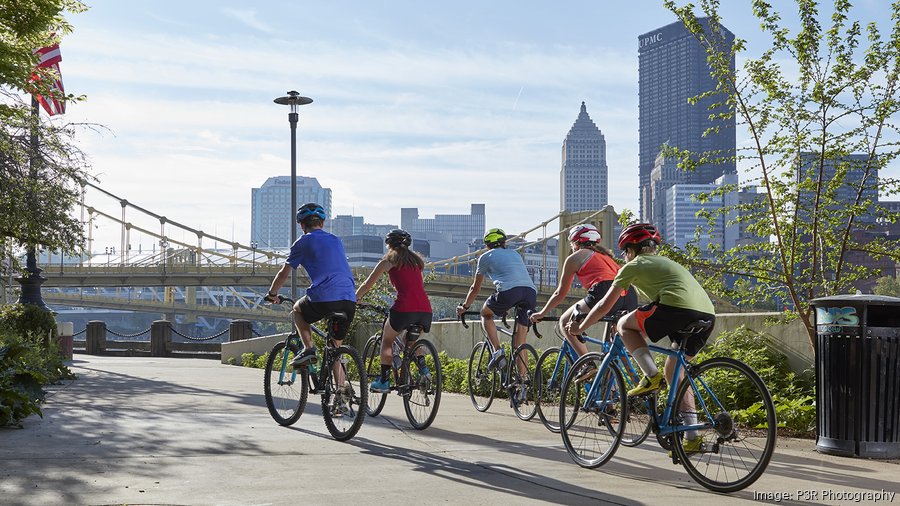
Cyclists pedal along the Three Rivers Heritage Trail. (P3R PHOTOGRAPHY)
By Mitra Nourbakhsh, Pittsburgh Business Times
With more than a million visitors each year enjoying the trail network along the region’s rivers, a new report estimates use of the Three Rivers Heritage Trail bolstered the economy to the tune of $26.5 million in 2023.
The Friends of the Riverfront, which manages the trail, released the impact report, which found the trail’s use also brought in $5.7 million in tax revenue and helped spur $987 million worth of development.
The over 33-mile trail network wraps around the Point and runs along the banks of each of Pittsburgh’s rivers. Data collected by counters placed along the trail estimated 1.3 million user visits in 2023, a twofold increase from 2014, the last time large-scale data was collected.
Consultant group Fourth Economy used 912 voluntary survey responses to put numbers to the trail system’s economic, health and community impacts. The conclusions, which are estimations, are used to convince funders that the trail is a worthwhile investment.
The economic impact is divided into two categories: Direct, and indirect or induced. The report estimates $22.4 million in direct economic impact, and an additional $4.1 million in induced or indirect impact.
To get a full picture of all spending the trail creates, the direct impact category includes spending on consumable and durable goods and spending generated by overnight visitors. Those categories are wide-ranging, and include metrics like the amount overnight visitors spend on accommodation, which came to $4.3 million. Calculations also showed that the average trail user spent $10.01 each on consumable goods, which include things like cultural venues, bike shops, ice cream and restaurants.
These numbers, however, are all based on a series of assumptions, said Fourth Economy Vice President Jerry Paytas.
For example, the report claims the trail’s carbon footprint savings are equivalent to 233 gasoline-powered cars being taken off the road. That number was calculated based off an assumption that each of the 13% of trail users who reported they used the trail primarily for transportation or commuting were replacing one car trip per day with a bicycle trip, meaning they would save 0.5 tons of carbon dioxide per year.
“All of these are assumptions based on some standard models or estimates,” Paytas said. “We’re not really able to calculate [margin of error] because it’s all just driven by these assumptions. The 233 number could be much higher, could be lower — but we aim not to overestimate.”
Fourth Economy compared the results of this report to other trail impact studies to ensure they are in the same ballpark.
Kelsey Ripper, executive director of Friends of the Riverfront, also acknowledged how hard it is to isolate the impact of the trail when it is part of a broader Pittsburgh experience.
“It’s always going to be a little challenging to figure out how to be able to tie spending directly to one thing or another,” she said. “Because when people come and travel to a city, they’re probably going to a ball game, and also going to the trail, and also going out to restaurants, and so I’m not sure you can completely isolate all of those things, but we trust the economists in their methods of being able to calculate those numbers.”
Still, Ripper said this report is a key “part of the puzzle” for the organization to continue developing the latest 35 miles of trail, a significant infrastructure investment. Friends of the Riverfront is using the data as it applies for federal funding, she said, and provided it to grant writers for the Allegheny Shores project.
The report also has been invaluable in revealing who the trail doesn’t serve. It shows that users were 91% white, and 42% had an income over $100,000. For comparison, Pittsburgh’s median income is $60,187, and the region is 63.1% white, according to the latest census.
Ripper said one of the organization’s goals is to expand the trail to more underserved communities and continue offering stewardship programs and events that encourage people to use the trail.
She emphasizes, however, that much of its impact is self-explanatory. It is the stories she’s heard from users about how the trail has impacted their lives, not the numbers, that truly encompass how integral it is to Pittsburgh.
State Sen. Lindsey Williams of Senate District 38, whose represents much of the trail in the Allegheny Valley, echoed Ripper’s sentiments.
“My office regularly hears from residents and municipalities about the desire to reconnect to our riverfronts through trails and other recreation opportunities,” she said in a press release. “This data quantifies what we instinctively know — that the Three Rivers Heritage Trail and Friends of the Riverfront provide enormous economic, health and community benefits to the entire region.”
Mitra Nourbakhsh is a student at Northwestern University and one of 10 Pittsburgh Media Partnership summer interns. Mitra is interning with the Pittsburgh Business Times.
 Pittsburgh Media Partnership