
By Liza Manning and Mitra Nourbakhsh, Pittsburgh Business Times
It took a four-hour drive across Pennsylvania, over $1,000 for accommodations and an almost-sleepless night setting up his tent, but by midday on June 5, Neil Claypoole was finally ready to start selling handmade wooden spoons at the Dollar Bank Three Rivers Arts festival.
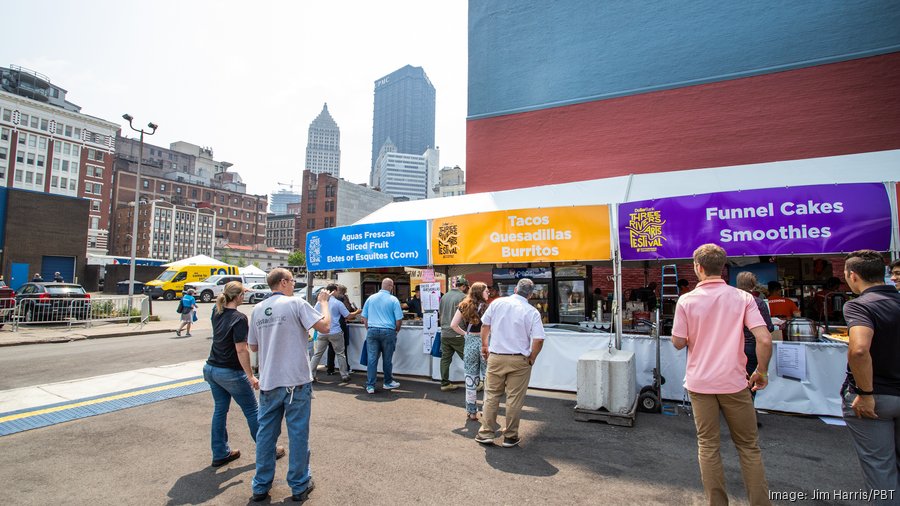
Having made it through the always-chaotic load-in process, the second half of the festival, which runs May 31-June 9, is now in full swing. Those who stopped by during its first six days can go back this weekend and see an entirely new set of artist’s work. Vendors say they expect a successful weekend of sales as organizers try to return the festival to its pre-pandemic success and experiment with a new layout.
This year, the chosen layout meant expanding onto the Rachel Carson Bridge, an exciting prospect for woodworker Tyler Lucas. Lucas is a full-time artist and often travels to shows, but setting up on a bridge was a new experience even for him. The location, however, got good reviews.
“The view is nice,” his wife, Jessica Lucas, said. “And there’s a little breeze.”
According to Sarah Aziz, Interim Vice President of Programming and Manager of DEAI Initiatives for the Pittsburgh Cultural Trust, organizers changed the layout of the festival to make more room around the main stage while maintaining the parts that worked best — namely, the artists’ market along Duquesne Boulevard.
The new layout made room for 326 vendors. Those artists were all selected by a jury; another 300 or so didn’t make it into the festival.
According to Tyler Lucas, artists who make jewelry or clothing usually have the most competition. This festival is often his most successful of the season, so Lucas says he makes an effort to have a competitive application.
“I try to make sure we stand out and make something a little more unique,” he said.
Before the pandemic, only 37% of those who applied were accepted. Aziz hopes to encourage more artists to apply for the festival in coming years to get back down to the pre-pandemic acceptance rate.
“We are working really hard with our marketing departments and with lots of other folks to make sure that different artists know about the show and know to apply,” Aziz said.
Attendance, she added, is looking similar to previous years. While exact numbers will not be available until after the festival ends, Aziz gave a ballpark estimate of 300,000 attendees.
The festival’s expansion onto the Rachel Carson Bridge was practical, as the bridge would have to be blocked from traffic regardless, but also an opportunity to highlight the beauty of the city it takes place in.
“We wanted people to know they were in Pittsburgh,” Aziz said. “And a bridge is very Pittsburgh-y.”
Aziz said her main goal is for the vendors is, above all else, to come away from the festival with an appreciation for the city it takes place in.
One such vendor is Holly Sue Foss, who grew up in Pittsburgh and has been coming to this festival for 37 years. Foss has had support from a plethora of teachers around Pittsburgh who have helped her on her mission to create the “happiest art in the world”.
“I just love festivals,” she said. “And there’s a lot of magic for me in Pittsburgh.”
Mitra Nourbakhsh is a student at Northwestern University and one of 10 Pittsburgh Media Partnership summer interns. Mitra is interning with the Pittsburgh Business Times.
 Pittsburgh Media Partnership